Resource Comparison
Best Step 1 Prep Courses for 2026: An Honest Comparison
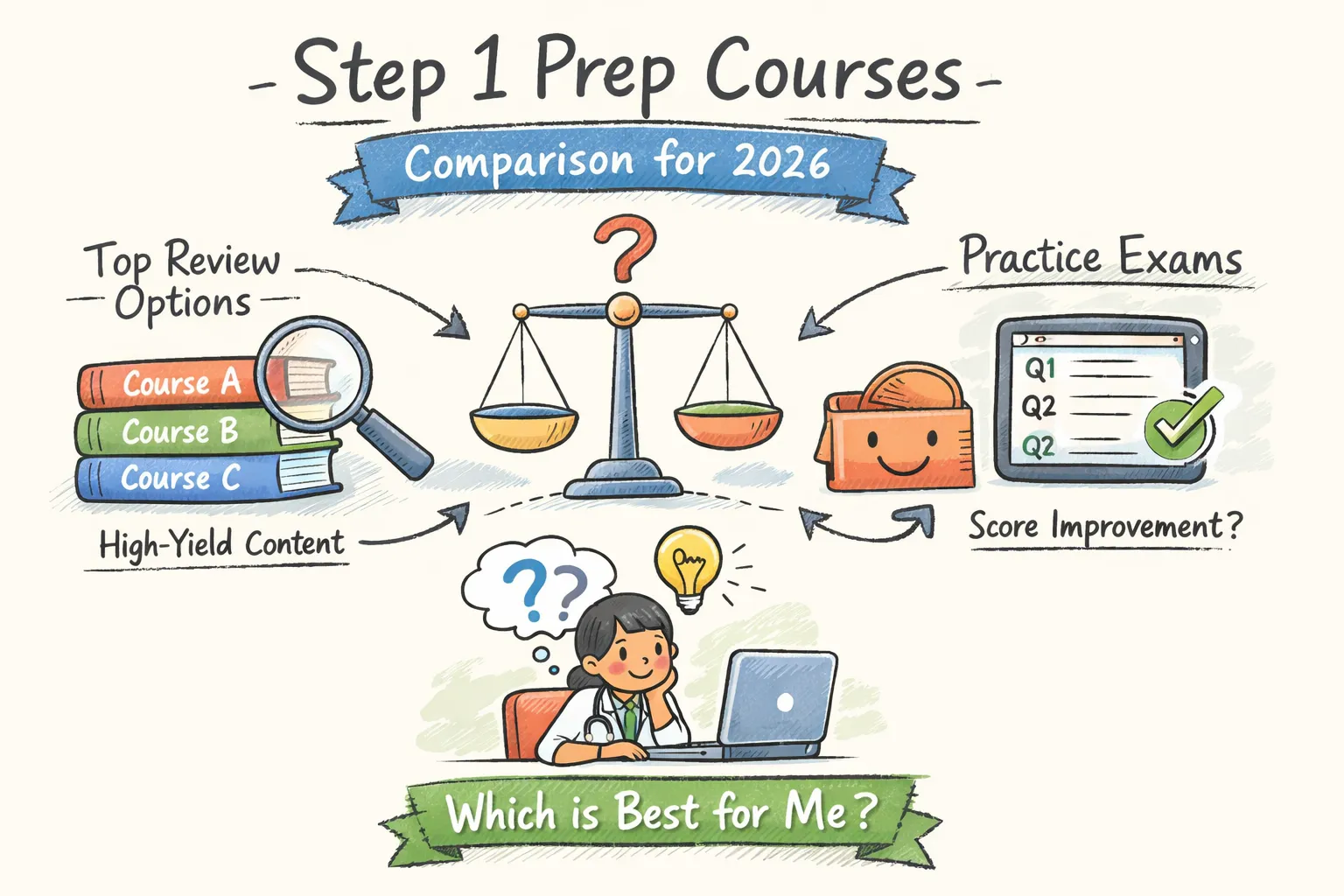
Choosing the best Step 1 prep course is a decision most medical students make too quickly and often get wrong. They spend more time picking a course than evaluating whether that course actually fits their learning profile, timeline, or current score level. The result is predictable: wasted weeks, a lighter bank account, and an NBME score that barely moves. The course gets blamed, a new one gets purchased, and the cycle repeats.
Here is a pattern that tutoring programs like High Yield Board Prep see consistently: students arrive having already completed one or two full prep courses, and their scores are still stuck. The course itself is rarely the problem. The mismatch between what the course delivers and what the student actually needs is almost always the real issue. That insight shapes everything in this comparison.
By the end of this article, you will know which course fits your specific situation, what you should realistically expect from it, and when a completely different approach makes more sense than buying another subscription.
What Actually Separates a Great Step 1 Prep Course from a Mediocre One
Most students compare courses on brand name or price. Those are the two least predictive factors for score improvement. Before you spend a dollar, you need a better framework.
Four criteria actually determine your outcome:
- ▸Learning style alignment, whether you absorb material through video lectures, text-based reading, or interactive question-driven formats.
- ▸Timeline fit, an 8-week dedicated period demands different tools than a 4-month slow build.
- ▸Foundation level, students who need a content rebuild require something fundamentally different from students who need test-mechanics refinement.
- ▸Qbank quality and review depth, based on observed patterns from high-volume tutoring programs, students who complete around 3,000 to 4,000 questions with rigorous wrong-answer analysis consistently outperform those who rush through twice as many without meaningful review. Volume without review is just expensive practice at making the same mistakes.
On pricing and refund policies, the market breaks into three tiers: Qbank-only options around $200, on-demand bundles running $1,000 to $1,300, and live online formats approaching $4,000. Most live courses at the premium tier include some form of pass guarantee or credit toward a repeat enrollment; on-demand courses typically offer 7- to 14-day refund windows, so read the fine print before committing. Higher cost does not automatically produce higher score gains. What it usually buys is more structure, accountability, and scheduled support, genuinely valuable for some students and completely unnecessary for others.
The Top Step 1 Prep Courses, Evaluated Honestly
Below is a direct look at what each major course actually delivers and who it serves best.
Kaplan Medical: the full-package option
Kaplan's on-demand course includes 1,100+ videos across 330+ hours of content, a Qbank with 2,600+ questions, 7 volumes of lecture notes, an AI tutor, and two full-length simulated exams, priced between $1,100 and $1,300. The live online course adds 270+ hours of interactive live classes, three 1-on-1 advising sessions, and a pass guarantee, coming in around $4,000. Kaplan suits students who want a single-vendor solution with institutional structure and do not want to make decisions about which resources to combine.
The real weakness is personalization: the curriculum is the same for every student regardless of where they are weak. The Qbank volume is also lower than UWorld or Amboss, which matters for students who learn primarily through questions. For a deeper look at how the major Qbanks stack up, see our own breakdown of UWorld vs AMBOSS. Kaplan works best as an accountability structure, not as a precision tool.
Boards and Beyond: the video lecture standard
Boards and Beyond has become the default recommendation for visual learners who want concise, high-yield content. At $149 for 6 months or $199 for a full year, it is the most affordable premium option on this list. The February 2026 update brought 502 HD videos with PDFs and over 3,300 quiz questions across 22 categories, with new chapters covering Anesthesia, Neurology, and Renal Physiology; you can review the current Boards and Beyond Step 1 package details here.
Boards and Beyond works best as a complement to a Qbank, not as a standalone. Students who need active recall and want to build test-taking instincts through question volume will find the course limiting on its own. Pair it with UWorld and you have a combination that covers most students with solid foundations extremely well.
Lecturio: the integrated alternative
Lecturio combines video lectures with integrated Qbank questions and spaced repetition inside a single platform. For students who want one login and a built-in active recall system, it removes the friction of managing multiple resources. The free entry point, with 1,000+ questions accessible without a credit card, makes it easy to evaluate before committing.
Compared to Kaplan, Lecturio is more affordable and more integrated. Compared to a Boards and Beyond plus UWorld stack, it offers fewer total lecture hours but delivers a more cohesive study experience. It is the right call for students who work better with a consolidated environment and want the Qbank to feel like a natural extension of the lectures.
Amboss and Med School Bootcamp: the rising alternatives
Amboss has built a strong reputation among students who want to understand mechanisms deeply, not just memorize patterns. Its knowledge library of 1,400+ articles and adaptive sessions make it particularly strong for students preparing for clinical reasoning components. The Anki integration is a practical advantage for students already using spaced repetition systems. The tradeoff is that some students find the questions overly granular, which can create anxiety rather than clarity.
Med School Bootcamp positions itself as a more digestible video course with short lectures (8 to 20 minutes), integrated quiz segments, and a detailed 9-week schedule built into the product. Student feedback consistently cites strong value and practical pacing. For budget-conscious students who want structure without the Kaplan price tag, Bootcamp paired with the Amboss Qbank is a competitive combination worth evaluating.
Live Course vs. On-Demand: Which Format Builds Your Score Faster
Most students default to on-demand out of habit. That is fine for many, but the format decision deserves deliberate thought before purchase.
When a live or intensive course format earns its premium price
Live courses like Kaplan Live Online work best for students who struggle with self-discipline, need external accountability, and have concentrated time to commit. For a 2- to 4-week intensive leading up to exam day, live formats create immersion and rapid content coverage. The premium price is essentially paying for structure and momentum, both of which are genuinely hard to manufacture on your own when motivation is low.
If you have repeatedly failed to hit your daily study targets during self-paced periods, that is diagnostic information. A live format addresses the behavioral problem that a better course selection alone cannot fix. The schedule becomes the accountability mechanism; the content is secondary.
Why the self-paced plus Qbank combination dominates for most students
For dedicated study periods running 8 to 12 weeks, a self-paced video course paired with a high-quality Qbank gives you the flexibility to revisit weak areas without the pressure of keeping up with a live cohort. This format rewards analytically minded students who track their wrong-answer patterns and adjust accordingly. The score gains come from the review process, not the lectures themselves. Students who watch lectures passively and move on are using the most expensive note-taking system ever built.
What the Evidence Suggests About Score Improvement and Prep Resources
Patterns from USMLE tutoring programs and publicly available UWorld outcome data point in the same direction, and it is uncomfortable for anyone selling a lecture-heavy course. Qbank performance correlates with score improvement, but the relationship is about review quality, not question volume. Students who work through 3,000 to 4,000 questions with genuine wrong-answer analysis tend to outperform those who rush through twice as many without stopping to understand why they missed each one; see a focused discussion on how many items you actually need.
Lecture hours, on their own, show a weak correlation with score gains. Passive video consumption rarely moves the needle in a meaningful way. Students who use Boards and Beyond or Kaplan lectures effectively treat them as frameworks, then immediately test those frameworks through questions. The lecture is a setup; the Qbank is where the learning actually happens. There is a growing body of research supporting active retrieval and targeted review over prolonged passive review.
There is also a personalization gap that no fixed curriculum can close. Every course on this list delivers identical content to every student, regardless of their NBME baseline, UWorld performance data, or specific error patterns. For students whose weak areas are scattered and non-obvious, a fixed curriculum will keep covering things they already know while leaving actual gaps untouched. That is not a flaw in execution, it is a structural limitation of the format.
When the Best Step 1 Prep Course Still Will Not Be Enough
This is not a knock on prep courses. It is an honest diagnosis of when the course-as-solution model breaks down entirely.
The plateau problem: why fixed curricula fail certain students
If your NBME scores have stalled despite consistent studying, the problem is almost certainly not the course you chose. A course cannot distinguish between a genuine content gap and the mechanical patterns that quietly drain points across every block. It delivers the next lecture on schedule, regardless of what your actual problem is. For retakers and plateaued students, switching to another fixed curriculum repeats the same cycle with a different logo. The same trap applies after a failure; see our separate post on preparing for a Step 1 retake.
The students who struggle most in this model are the ones who have already put in the hours. They have done a course, they have done UWorld, they understand the content at some level, and the score still will not move. That is not a content problem. That is a diagnostic problem, and no lecture series solves it.
How 1-on-1 tutoring adapts where courses cannot
This is where High Yield Board Prep enters as a direct solution. Unlike any fixed-curriculum course, a personalized 1-on-1 tutoring program builds your study plan from your actual NBME baseline and UWorld wrong-answer data, then recalibrates it weekly based on what the data shows. High Yield Board Prep's proprietary wrong-answer diagnostic categorizes errors into mechanical versus content-based causes, then prescribes a specific fix for each. No video course does that, because no video course knows who you are.
For students who have already tried one or two courses without results, this level of diagnostic precision is what changes the trajectory. Wrong-answer audits typically reveal that 30 to 50% of most students' errors are mechanical, not content-based, which means more lectures are the wrong medicine entirely.
How to Pick the Right Step 1 Resource and Move Forward
Most readers arrive at an article like this already leaning toward a specific course. Use this framework to confirm or correct that instinct quickly.
Match your situation to a recommendation:
- ▸Strong foundation (NBME 65%+), good self-discipline, 8 to 12 weeks: Boards and Beyond plus UWorld. This combination covers the majority of disciplined students who are analytically tracking their errors.
- ▸Needs structure and accountability: Kaplan Live Online or a comparable live intensive. You are paying for the schedule, not the content.
- ▸Wants an integrated platform with built-in Qbank: Lecturio or Amboss. Both consolidate the experience without requiring resource juggling.
- ▸Visual learner, limited budget: Med School Bootcamp for lectures, Amboss Qbank for questions. Strong value combination.
If you have already completed a Step 1 review course and your scores have not moved, stop adding more resources. The problem is diagnostic, not volumetric. A single session with High Yield Board Prep can identify whether your errors are mechanical or content-based and map a targeted path forward, something no additional course purchase can provide, because courses do not analyze your specific wrong-answer history.
The Bottom Line on Choosing the Best Step 1 Prep Course
The best Step 1 prep course is not the most expensive one or the most popular one on Reddit. It is the one that matches your learning style, timeline, and current performance level. For most students with a solid foundation and genuine self-discipline, a self-paced video course paired with a quality Qbank is sufficient. Choose the combination that fits your format preference and budget, commit to rigorous wrong-answer review, and do not confuse hours logged with progress made.
For students who have plateaued, failed, or simply cannot afford to guess wrong again, a fixed curriculum is the wrong tool. The best USMLE prep course in the world cannot tell you why you are missing questions. That requires a diagnostic approach, not another lecture series.
If you are still deciding on a course, use the framework above. If you are past that point and your scores are stuck, High Yield Board Prep offers a first-session diagnostic to identify exactly where your score is leaking and what to do about it. That clarity is worth more than any course you have not tried yet.